
Are gas guzzlers more sustainable than EVs?
OPINION
Written by: Saud Khan
Artwork by: Gauri Bhople for The Fraser Post
Edited by: Iraa Kulkarni
Designed and Formatted by : Mustafa Saleem
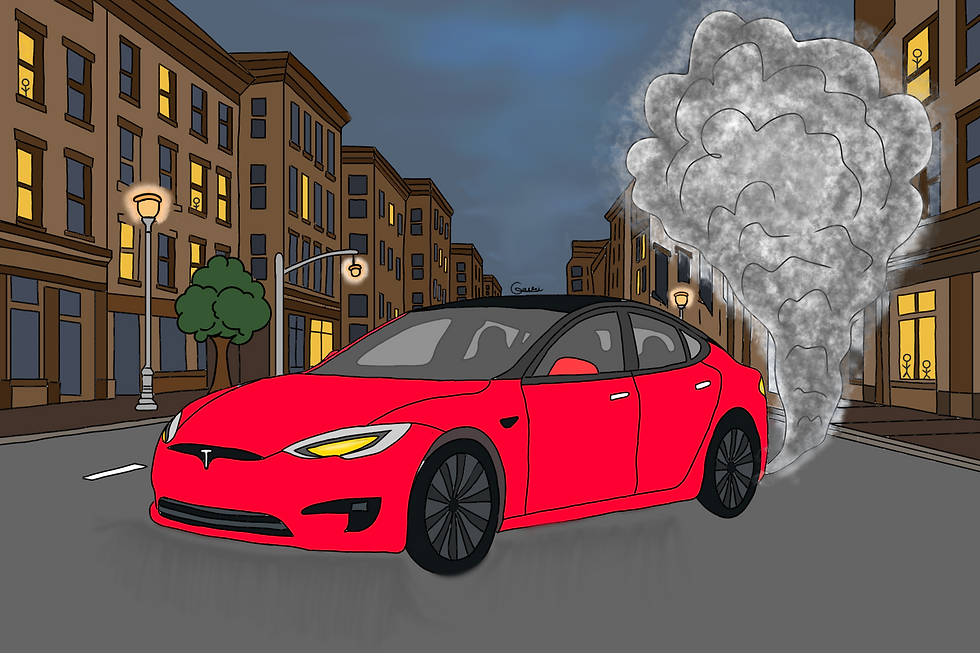
For the past decade, electric vehicles have been seen as the main renewable option for a car. However, this perception may be proved incorrect, as EVs also produce significant amounts of greenhouse gases through production of their batteries and their electricity source (e.g. coal), maybe even more than “gas guzzlers”.
An electric vehicle’s main pollutant is its own battery. What may seem renewable actually produces lots of emissions during production. On average, a Tesla battery will produce 7,300 kg of carbon dioxide while in production–equivalent to about two years of driving in a gasoline car. However, there are also other social impacts. For example, in 2016, hundreds of protesters in China threw dead fish onto the streets of Tagong, Tibet in protest of the lithium mine (which provided the lithium for EV batteries) that was polluting their waters. The Chinese government was then forced to shut down the mine. All in all, the battery is the main culprit, producing a significant amount of CO2 before the car is driven, while also impacting the lives of many people worldwide–and not in a good way.
Another main (and unintentional) pollutant of an EV is their energy source. If an EV is being charged by burnt coal or petroleum, then the benefit for the environment is about the same as a normal Toyota Corolla. In a study conducted by Reuters, it was estimated that an EV being charged with non-renewable resources would take five years for the EV to have lower carbon emissions than the Corolla, but after a decade, the gap would still only be a million metric tons of carbon dioxide between the two cars. While it may seem large, both cars would have produced over 50 million tons of carbon dioxide by this time.
Although the previous statistics may look bad, electric vehicles can be extremely good for the environment, provided they meet the right conditions. Firstly, the battery needs to be improved. While mining lithium is non-renewable (for the time being at least), there is still plenty of it to go around. Finished batteries can be recycled into new ones, and they will perform just fine. Another main culprit that needs to be solved is the energy source. In order to keep EVs renewable, they need to be charged by renewable energy (e.g. solar, hydro, etc.). While hard to do, it’s certainly possible.
In conclusion, while electric vehicles are better for the environment than their gasoline-powered counterparts, it still is not enough. In order for EVs to become carbon-zero, they need to rethink their structure, from their battery to their fuel source. While the EV may be marketed as a sustainable alternative, it still has some ways to go to live up to the claims.