
Written by Olivia Yang
Artwork by Eleen Zhou for The Fraser Post
Edited by Yash Gupta
CREATIVE
We Are The Dead - A Short Story
“We are the Dead. Short days ago
We lived, felt dawn, saw sunset glow…”
–an excerpt from In Flanders Fields by John McCrae
Belgium during autumn wasn’t nearly as chilly as Canada, but in Canada, there were two-layer sewn blankets, a well-kept fire, and his mother’s carrot stew waiting for him. In Flanders, Belgium, there was nothing for him but a thin sheet over dirt and cold iron. But still Alexander slept. It was a luxury to sleep, and in that groggy, mind-muddled state, he could pretend he was home, curled up beside his English Setter, with the sunlight struggling in through the windows and his sisters bickering over something or the other downstairs. The smell of scrambled eggs wafted to his nose. His mother would wake him up, stroking his cheek softly. Alexander, she would say, air whistling through her cracked front tooth. She’d broken it playing in the creek as a girl, and so never let him or his sisters there. They’d sneaked out, of course. She only found out once, and when she did, she hadn’t even yelled at them. She’d always been so soft-spoken. It’s time to get up. Dawdle any longer and your sisters will have eaten everything. Alexander, sweetheart.
“Alexander,” a man’s voice whispered.
He shivered and curled into himself. Someone seized his shoulders and shook him lightly.
“Alexander,” the voice repeated, and he pried open his eyes. Alexander felt as if he’d been slapped awake. Suddenly the stench of the unwashed bodies and rot struck him as if it was the first few days all over again. He thought he’d already gotten used to it.
Then clarity set in, Alexander’s hand flying to the rifle at his side as he sprung upright.
“We’re under attack?” he gasped, voice coming out far too loud. William pressed a calloused finger to his lips, shushing him, eyes wide. Alexander fell silent, and a small, impossible smile broke out onto William’s thin face. He and William were from the same town. They’d never met—the town was far too big for that—but after discovering their shared origins and that they were both seventeen, they’d taken to treating each other like childhood friends.
“Follow me,” he said, sky-blue eyes darting around warily, ensuring that the others were still asleep. Already, Alexander knew he was doing something he wasn’t supposed to. He shuffled away from him, frowning. Punishments were severe, and though he cared for William, he didn’t care enough to get punished for him.
“What are you doing—”
John came up beside William, both of them not wearing their steel helmets. He frowned. “You’re still in bed?” He was nineteen. Before they’d all gotten their heads shaved, he had an almost girlishly long haircut. He and William had made fun of him for it, from which he tried defending himself by saying that he hadn’t enough money to cut it. Now, he was the same as the rest of them, if not more masculine, but it still felt strange to see him without long hair. John made an impatient beckoning motion. “Hurry up.” Then he disappeared again.
Confusion pricked at Alexander’s senses.
“This isn’t allowed,” he said dully.
“Just shut up and come,” said William giddily, eyes brighter than anyone’s since their deployment. It was almost magical to see, an impossible sight. That alone lured Alexander to trail behind him with little more than a mumble of complaint.
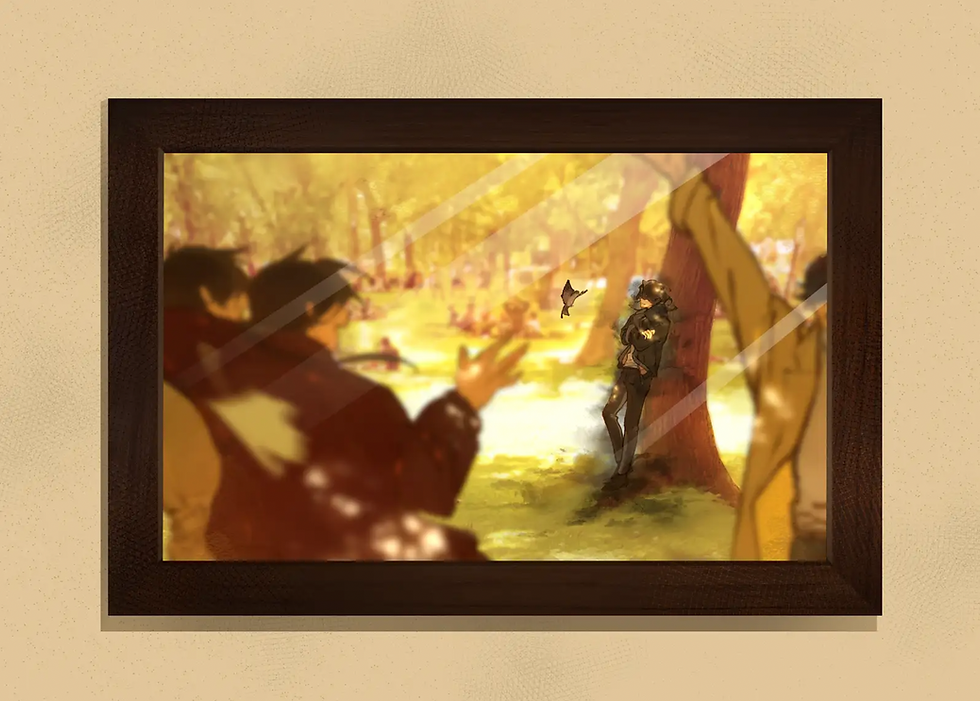
They climbed to the top of the trench, opposite of the No-Man’s Land. William led them to a place far enough from the trench so that they had grass to sit on, but close enough to make a hasty escape. The sun was going to rise soon, casting the sky in a soft blue. It was warm, and if Alexander closed his eyes, with the gentle breeze flitting over his dry skin, he could pretend he was home.
But he was never home. The stink of war— the sour smell of rot, the metal of spilled blood, the lice and sweat and urine— always lingered. It crept into his bloodstream, infused with his skin. Sometimes he thought that if he were to somehow make it home, the stink would never wash out.
“We thought it’d be nice to watch one last sunrise,” said William in the silence. “Before…”
He didn’t need to continue. They both knew how the sentence ended. They knew how all this would end. The image had been pressed into their eyelids. If they fell, there would be no time to mourn for them. They wouldn’t be laid to rest or given a ceremony. They had been camped out for weeks now, and still the bodies from the first day rotted on the expanse of the No-Man’s Land.
“I don’t want to think of stuff like that today,” said John, as if reading his mind. “Let’s just enjoy this while we can.” He nudged Alexander and William in the side. “Let’s talk.”
“About what?” said William. His hair was starting to grow out, and glowed in the morning light.
“Anything,” he said. “Nothing.”
“We don’t have time for meaningless things like that,” said Alexander irritably.
“Just pretend we do,” he sighed. “Fine, I’ll start.” He reached into his shirt pocket and drew out a folded picture, the paper thin and crinkled. Alexander knew it was a photograph before he even showed them the front. John cradled the paper like it was a flower or infant, like it’d tear under an ounce of pressure. Maybe it would.
“This is my girlfriend, Clara.” John’s voice was softer than they’d ever heard. Alexander wondered if it was appropriate to poke fun at him for it. William, originally disinterested, rested his head over Alexander’s shoulder to see. The girl had short brown hair, curled to her nape, with a square jaw and thin lips. In the photograph, she was grinning ear-to-ear, holding a bouquet of roses. He could feel the joy radiating from it, the giddy feeling of being in love. He could see it in the girl’s coy blush. Her dark eyes were not focused on the camera, looking instead beyond the lens and fixed on the person behind it. The look of love was such a cryptic concept to explain. It was so much easier to describe it. Her eyes were lifted, bright, and curved into crescents, eyeing the photographer with a mix of shyness and conviction.
“This feels like I’m interrupting something intimate,” whispered William under his breath, so quiet that Alexander wouldn’t have heard if it weren’t for their proximity.
“You took the photo?” asked Alexander.
John didn’t answer for a moment, staring wistfully at the photograph, turning it slightly away from them, in a sort of childish protectiveness. “Yeah. I’ve always been fascinated with photography. It’s amazing, isn’t it? I think we’re treating it far too seriously, though. Photography ought to capture people at their rawest, happiest moments, not… so grave. That’s not how I want people to remember me. That’s not how I want to remember my Clara. She’s always smiling, laughing. What use would I have of a photograph where her expression looks as if I’ve already died?”
A corner was folded. Unthinking, Alexander reached out and pinched the bottom-right corner of the photograph straight. He froze after a moment of clarity, thinking John was going to snap at him, but he didn’t. He just looked at him bizarrely for a moment, then slowly let it go. Once it was out of his hands, his eyes never left it.
“What was— what is she like?” asked William.
“We were childhood friends first,” he said. He looked towards the horizon, eyes burning quietly with the sunrise. “We used to be neighbors, but then she moved a few streets away. We were seven, I think. I still remember how distraught she was. She thought we’d stop being friends. I’d bike to her house after school every day. Our mothers were friends, too, which helped.” He paused for a moment. “A few weeks before the war started, I asked her family for permission to begin courting her, and they said yes.”
“What was her reaction to it?”
“Her reaction? She told me. She grabbed my collar and said—” his voice rose an octave in imitation— "John Taylor Thompson, quit your dilly-dallying and ask me to be your girlfriend already.” He lifted his shoulders in a half-shrug. “I had been dilly-dallying. I was scared.”
William snickered.
John looked indignant. “Don’t laugh. It’s not funny. You’ll understand the feeling one day.” He leaned back on his palms, tilting his head up to the breeze. “I wish I’d told her sooner. We could’ve had more time together.” There was a note of distinct, sharp pain in his voice. “I could’ve admired her openly, instead of sneaking glances. Glances that she knew about, of course.” He laughed, but it was as dry as the autumn wind passing over crinkled leaves. “I wasn’t as crafty as I thought I was.”
All three of them were silent. Alexander thought of his future often after being drafted; he’d never really thought about it before, but now the concept, of finding a girl, of falling hopelessly in love with her, was something he yearned for desperately. It was in all the pep-talks, the speeches. Do this for your mother. For your father. For your wife and children. How nice would it be to have something so dear to him, that he’d go to war for it? He had his parents and sisters, of course, but that was different, in a way. His eyes wearily fell upon the battlefield. He could feel John staring at him.
After a moment of silence, John said solemnly, “Look up.”
Alexander’s gaze snapped up. “What?”
“Look up, not down. Not at the ground. Look at the sky.” He pointed ahead, the sun beginning to peek out, tracing a path on the blushing horizon. “If you look down, you’ll never stop looking. You’ve got to look ahead. That’s the only way you’ll survive.” He paused for a moment, then said, “Did you know that other armies spread out their soldiers? In our army, they recruit from the same region, from the same towns. Do you understand what that means? If people in our division die, entire communities can die out. There’ll be no men left from that town.” He closed his eyes, his pale skin awash with the hues of sunrise. When he spoke, his words were placed delicately, as if they’d shatter upon meeting the air. It reminded Alexander of his father, and his low-rumbling voice. “I’ve been thinking about that a lot recently. No one will remember the serious look on my brother’s face when he’d blacksmith. No one will remember how me and my friends would dawdle in school and pass each other candy when the teacher wasn’t looking. So many stories and experiences, erased. And no one to live on.” He opened his eyes. “That’s why we should talk to each other now.”
“What are you going on about?” muttered William.
“Even if I die, I won’t be another faceless soldier to you two. You will have remembered how I loved my Clara, our story. You will have remembered me as a person, and so I will live on through your memory.”
Live on through memory. It was a sentence he’d heard many times in the war. It was meant to be comfort, for the brothers they had no time to mourn. So long as the rest of them lived, the dead would live on through their memory.
William and Alexander exchanged a weighted glance.
“That makes sense,” said Alexander.
“How long do we have?” asked William flatly.
“I don’t think an assault is scheduled for today.” He sounded exhausted. They all sounded exhausted. “But the enemy will always be the enemy, regardless. When the sun comes up completely, we should go back down.” He let out a listless sigh and tore a blade of grass from the earth, lifting it to the air. It flitted back and forth, casting a shadow upon John’s face. When he let it go, the wind caught and carried it away. He cast them a glance. “So,” he said, “who’s next?”
William wouldn’t say a word, so Alexander spoke. He spoke of his mother’s carrot soup and her broken tooth, of the firewood in the living room endlessly stocked by his lumberjack father, of his sisters’ endless bickering. Always, it was something or the other about stealing each other’s belongings. He’d always been irritated by their chatter before; he woke up hearing it and went to sleep hearing it. But that had been infinitely better than waking up to gunfire, or because it was too cold to sleep, or because it had rained, and all of them had to shovel out the rainwater before it accumulated and drowned them all. It was infinitely better hearing them in the other room and knowing they were safe, than living in fear that if they didn’t win the war, they’d die. And how would they defend themselves? Mildred might be of help, since she was the second-eldest and had accompanied their father to cut trees since she was very young. She was strongly-built, outspoken, and braver than him. Her brown hair was always in braids, bouncing against her shoulders as she walked. Helen had taken after their mother, daintily-constructed, placid and reserved. She lived in her own world, and sometimes would grace them with a glimpse of it, at night when all five of them told stories in the living room. She could spin a story out of anything, and whenever Alexander had free time, he’d write them down for her. When she recalled details, her hazel eyes would turn to the wooden floors, casting her long lashes across her freckled face— just like their mother. A year or two prior, she’d begun wearing her hair like their mother as well, dirty-blonde locks swept up into a complicated bun Alexander had always found flummoxing. He’d tried it, once, and achieved nothing but morph Helen’s head into a bird's nest. Although Helen took after their mother, she didn’t have her endless stream of goodwill, and threw a chair at him.
“A chair?” William echoed in bewilderment.
“A small chair,” repeated Alexander. “To be fair, she was
meeting with a suitor that day.”
William seemed to derive joy from his mistakes, a large grin splitting his face. “And you ruined her hair! Good Lord, how did the gentleman take it?”
He coughed. “They did not meet a second time,” said Alexander, head hung.
William threw his head back and laughed.
“Our mother had other business to attend to, and Mildred was out gathering firewood with Father!” Alexander cried in his own defense. “Who else could’ve helped her but me?”
John shook his head. “Alexander…” He sighed, rubbing away a small smile that was crawling up his face. “Just continue with your story.”
“I don’t know what else to talk about,” admitted Alexander after a moment of consideration. “Perhaps it’s William’s time, anyway.”
“You haven’t talked about yourself much yet, I think,” said John.
Alexander lifted his shoulders in a shrug. “It feels like I haven’t lived that much yet.” He rubbed the back of his neck, looking up at the sprawling sky. “I thought that I’d… That it’d all get more exciting when I got older. Actually, I thought that this war was it. That it’d be the exciting thing of my life. I mean, an actual war. It sounded so fun, like jostling around with my friends after school, or a monomyth. An adventure where I was the hero.” He shook his head. “I was so daft. I wish someone had warned me. But who could have? Who knew it’d last so long? Who knew the sort of horrors I’d witness? Who could have possibly warned me, when this war is unlike anything we’ve ever seen? I feel as if I’ve aged fifty years.” He shook his head. “I cannot blame anyone but myself. I signed my name onto the sheet, and I yelled at Mildred when she begged me not to go. I should have known then. Mildred never cried over anything.”
“Do you regret coming to fight?” asked William, his ice-blue eyes ever paler in the early-morning light. The sun’s beams peeking over the horizon cast half his face in shadow, making his harsh features harsher. He hesitated. “How would you have… tried to avoid going, if your family had wanted you to go?”
Alexander searched his friend’s eyes with a furrowed brow, then said slowly, “I think that I would have come somehow. If not at the beginning, then sometime afterwards. The way I am, the way my family is… I think that the fact I’m here is inevitable. I would have ended up on the frontlines somehow.”
“All the soldiers have been writing letters, talking about what they’ve seen. The disrespect to the bodies, the horrors, the stench. Once it gets around, no one’s going to come willingly. If the war is still ongoing for a year, then I think that’ll be another reason why people won’t join,” mused John, flexing his shoulder. “No one wants to join an endless fight. After that, they’ll have to force people to join. We’ll be the last soldiers to have come willingly.”
“What you said, William,” said Alexander. “Is that what happened to you?”
William shrugged half-heartedly. “I mean, it’s as you said. I would’ve gotten here either way.” He gestured flippantly to John. “And besides, you heard John. It doesn’t matter. At least this way, I’m not as much of a disappointment to my parents.” He counted on his fingers. “Here, I’ll do my part. One, my name is William Clifton, and two, when I was baptized as a babe, the priest’s hold on me slipped and I almost drowned in the basin. You don’t have to look so frightened. It’s funny. Whenever I run out of things to say, I can tell that story. It’s a hit each time. Three, I have a mother named Florence Mary, maiden name Anderson, and a father named George Clifton. Four, I have no siblings, because the doctor said my mother could die if she conceived again.” He shrugged. “My father has always been a strict man, but he’s nothing if not a good husband. For most of my childhood, he was content with just me. Agh, what else is there… Five… Five…” He trailed off, then fell silent for a moment, and choked out, “What is that?”
Alexander heard it before he saw it. It sounded like water droplets fallen upon glass, a handful of notes repeated over and over. It began softly, almost as if to test the air, then burst upward in a crescendo. A bird’s song. Alexander could hardly believe his ears, or eyes. A bird singing over a battlefield, the dawn on its wings. It felt almost symbolic. A strange feeling bloomed in his chest. It felt tingly and skittish. It warmed his chilled skin from within. It wasn’t quite hope, but not far from it, either.
“It’s a lark,” said John in disbelief. “Clara liked studying the songs of various birds. That’s a lark’s song, I’m sure of it.”
“What is a lark doing here?” said William, looking comedically stupefied. After a moment of puzzlement, he slumped to the ground and let out a victorious laugh, hugging his stomach and rolling over the grass. The pure joy on his face was unmistakable. He laughed and laughed, and that rare, impossible, mirth-filled laugh, that Alexander hadn’t heard for what felt like an eternity, caught. Alexander and John caught it like one caught a sickness, passed on from sitting too close to the contaminated. They laughed until their stomachs hurt. Just when any of them would stop, they’d just be contaminated again.
“What are we even laughing about?” gasped John. “Stop laughing, already.”
“This is a sign,” smiled William. “I didn’t really think it’d happen. It’s sort of embarrassing— but oh, well.” He grinned, flashing his teeth. “I prayed every night for a sign that I was going to make it out of this, that I’d make it home. I asked for it to come in the form of a bird, because to be frank, I was feeling awfully sorry for myself, and thought that no birds ever came through battlefields, anyway. But it came. Oh, my God, it came. Maybe there’s a God looking out for me after all. It really, really, came.” Hope made his eyes bright, brought a red flush to his cheeks. “Finally,” he whispered. He pressed the palms of his hands onto his eyes. His laughter stifled, and then he was silent and trembling. Dawn’s rays highlighted the tears running down his cheeks. When he gasped for air, it came out as a sob.
John and Alexander exchanged a glance, unsure. In the end, John settled a reassuring hand onto his left shoulder, and Alexander on the other.
“We’re going to go home,” said Alexander, and for the first time in forever, he felt that he believed it. “One way or another.” It sounded reassuring, but none of them voiced the rest of the sentence: either on your own feet, or heaved out alongside the other dead.
William sniffed. “But even then, people won’t remember us. No one’s looking at Flanders. They’re looking at the capitals, the borders. We’re just cattle, an afterthought.”
“History works in strange ways,” assured John. “You never know whose story shines after time has had its way with it. We are not faceless soldiers. We’re fighting for our country, and there has never been a man that does not appreciate his forefathers’ efforts. Don’t be so quick to assume the worst, my friend.”
“What if it’s for nothing? What if we do die today?”
“Then the living persist, and win, and honor us,” answered John. “We honor the dead by not surrendering. And if we die, then the living will honor us through their determination.”
He wiped his watering eye. “I don’t want to be remembered as a soldier,” said William quietly. “I’m not… this. This isn’t me. I don’t… kill people.” He shuddered. “I want to be remembered as a human being. I was someone, too. I never wanted to be here.” His voice broke. “I never wanted to be here.” He fell silent for a moment, and then spoke, very slowly, as if each word were tearing a piece of his soul from him, “I need you guys to help me. I can’t… read.”
“...What?” said Alexander.
“You heard me,” snapped William irritably.
“I didn’t take you as the type to skip school, William,” said John thoughtfully.
“Not all of us have the privilege to attend school,” grumbled William, looking at them with a mixture of disdain and embarrassment. “The farm needed me. My family needed me.”
“Oh, that’s right,” said John, snapping his fingers. “It slipped my mind that you have no brothers or sisters.”
William muttered something under his breath, then fished into his inner pocket and shoved a crumpled envelope into the space between John and Alexander. It was stained, and at first sight, Alexander almost thought it was blood. When he took it in his hand, he realized, with relief, it was only mud.
He turned to William then, chapped lips pulled into a slight frown. “And this is…”
“A letter. That I received.” His brow quivered, betraying the extent of his emotions. He jerked his head away, making a flippant gesture towards the paper. “I’m dumb, but not dumb enough not to recognize my mom’s name.”
“You’re not dumb, William,” said Alexander instinctively. Living with two sisters, the denial had been embedded into his nature. No, I can’t notice the wart from afar. You’re not a bad writer, the story sounds really interesting. No, I think that looks fine. You’re not useless, you’re ill and have to rest; should you work yourself any harder, your condition will only get worse.
William’s lip only curled in contempt. “I don’t need you to comfort me, Alexander. Just read the damn letter to me already.” He sounded as if the mystery of the contents was torturing him.
“William,” said John reproachingly.
“I’m sorry,” mumbled William. “Alexander, please read me the letter.”
Alexander hesitated for a moment, then pried open the envelope and drew out the paper within, unfurling the contents before him. He held it up like a squire recounting a message to a king; the motion was familiar. Sometimes he and his sisters would play make-believe. He cleared his throat, dark eyes flickering over the cursive scrawl.
“To my sweet William,” began Alexander. “I woke up early today. I was cleaning the table when I thought of you. Please do not misunderstand; I think of you every waking moment, and all my hours of sleep I spend instead lying awake. It was dawn, and I wondered if you were seeing it, too. It was beautiful, much too beautiful a scene for my tears. I thought about how it might look from where you are. Did the sun come over the battlegrounds and find you alive and well? Did you look towards it or squint your eyes? You have my blue eyes, but I think they’ve always looked better on you, with your father’s blond hair. I’ve always wondered how a second child might be different, but you know how that went. You are my precious only son. It was wrong of us to have sent you away. I hate to sound like I’m pitying myself, but I don’t know how else to apologize to you. You are your country’s soldier, but you were my son first. I should have never listened to what others said. I should have let you stay in my arms. But even then, I don’t think that would’ve lasted. I wanted you to find yourself. I wanted you to have friends and have a normal life like everyone else— things you never had time for in the life I gave you. Perhaps I was too pushy, and perhaps too impatient. So here it is. I’m sorry, William. I love you, and your father loves you. We are praying for you. And if you are hearing these words, then that means you have found friends, yes? I’m happy to know so. I hope that in between battles, you are able to find glimpses of hope and contentment. You do not have to return to us when the war is done, if you don’t want to. I know that you’re feeling hurt, betrayed, and angry, and I cannot fault you for feeling so. I hope that the war is a chance for you to discover a life beyond the meager opportunities I could’ve given you. Perhaps after rising in the army’s ranks, you shall save some noblewoman, and win the respect of her father, and be married into her family, and lead a good life, and never return to us. Perhaps you will have children with my blue eyes and your father’s blond hair. If that is what you choose, then I hope that, at least, when you look towards dawn, you will know that I am on the other side of the world, thinking of you.
That is all.
With all my heart,
Florence Mary Clifton.”
The letter ended with a kiss, pressed into the paper in faded red. Alexander ran his thumb over the words, then turned towards William and John.
“What do you think?” he asked.
William shrugged, his eyes firm upon the bleeding horizon. “I’ve never heard her so open.” He took the paper from Alexander’s hands and looked over the scrawl. “It sounds just like her, though.” He said nothing more.
“Are you two happy?” Alexander asked. “I mean, do you guys think you’ll be happy once the war is over?”
Silence. The lark’s song rang out in the morning air, reverberating through the battlefield.
“Someday,” said John. He swept a hand over the No-Man’s Land, over the fallen bodies. “So many of these bodies aren’t going to be identified. Their place in the ground will be marked with nothing more than the word, ‘soldier.’ Whether I die or survive, a part of me will stay here forever. Even if I am happy someday, mentally, I’ll still be here.”
“In the No-Man’s Land?” inquired William.
John closed his eyes. “If I’m lucky, right here. In the grass with you two, talking. Looking over the morning light before we have to return to the trenches.”
William considered this, gave a curt nod of agreement.
After a moment of pause, Alexander said, “That doesn’t sound so bad.”
“Yeah.” William squeezed his eyes shut. “I’m glad we did this.”
“Me, too.” Alexander let out a small sigh. “I hope this moment lasts forever.”
A sort of hope buzzed in the air around them, but it was fragile, and thin, its texture akin to the worn photograph in John’s calloused hands. If any of their voices penetrated the silence, it would flitter away like a startled butterfly. It was as valuable as it was hollow; all of them knew how it would end.
It was Alexander who broke it first.
“If I die, you two have to survive,” were the words. Then, quieter, so low it was only audible to himself, “Please, God. At least one of us has to survive.” He wrapped his fingers around each other and lowered his forehead to it. “Please, please…”
He had never begged God for much of anything. It felt strange to hear himself do so. He sounded so desperate he wanted to laugh. He sounded so desperate he wanted to curl into a ball and weep until the war was over, until he could hear his sisters bickering in the room over, until he was experiencing Canada’s biting winter winds once more.
He realized, then, in a moment of absurd clarity, that the two boys beside him were no more his friends than the mud on his sleeve. They were acquaintances of circumstance, only. The sole thing binding them together was desperation, the desperate, primal need to survive, one way or another. But God, he was so tired, and in that moment, beside them, was the first time he’d felt normal in ages. So he would talk, and tell them all his secrets and memories, as if they were blood brothers. If it gave him the comfort he so badly needed.
“So,” said Alexander, clearing his throat. “I just remembered something. Since I was a boy, I’ve always wanted to see France.”
The tension in the air loosened as a disbelieving look broke out on William’s face, and John raised an eyebrow.
“...France?” the two echoed in unison, exchanging a baffled look. “Why France?”
“Hey, hear me out…”
At the edge of a battlefield, three soldiers sat shoulder to shoulder, wrapped in the thin morning chill that the sun hadn’t yet warmed, mouths moving as they spoke animatedly about something. As the first faint glow stretched across the sky, they could taste the dew in the air, laced with a bitter hint of smoke from the previous night’s conflict. The freckled soldier closed his eyes for a moment, feeling the warmth of his friends beside him, steady and solid, a comforting weight against the chilly autumn air. The sunrise painted the hills in amber and gold, stretching across the landscape like a yawning chasm. The morning light cast their shadows long and thin across the ground, turning them into blurred, faceless things, mingling with each other.
It felt as though the earth itself was holding its breath, waiting. Their gazes drifted toward the horizon, and for a prolonged moment, it almost seemed that the moment was eternal, and they would never have to leave that safety. But as the shadows continued to stretch, and the sky continued to brighten, their conversation stifled. Two soldiers tucked their papers back into their pockets. One pressed a kiss to a black-and-white photograph, stalling for as long as possible before creasing the paper and hiding it away. The other folded his letter immediately and shoved it into his pocket. The third just watched, gaze flitting from his fellow soldiers to the sunrise.
When the sun rose completely, hanging over their heads like an executioner's blade, they rose from the soft, morning-bright grass and returned to the trenches to pick up their rifles.